What Magnification Do You Need for Stamp Collecting?
The best digital microscope depends on the task, not the largest advertised magnification. For coins and surface inspection, prioritise a stable stand, controlled lighting and clear image capture. For PCB soldering, choose enough working distance and usually stereo depth. Before buying, verify native resolution, connection type, UVC or app support, UK returns and the seller’s tested compatibility with your device.
What Magnification Do You Need for Stamp Collecting?
Stamp collecting needs little magnification — about 5x–30x for perforations and detail. How advertised 1000x/1600x figures map to a USB microscope, and what actually helps on stamps.
For stamp collecting you need surprisingly little magnification: roughly 5x to 30x covers almost everything — perforations, design detail and cancellations. Anything above about 60x is rarely useful. Even, steady lighting and a clean capture matter far more than pushing the highest magnification.
How much magnification do stamps actually need?
Less than the catalogues might suggest. Most philatelic work is comfortable in a low band and only occasionally reaches higher:
- Everyday sorting and design, about 5x to 10x. A traditional stamp loupe lives here. It is enough to read a cancellation, judge centring and colour, and keep the whole stamp in view.
- Detail work, about 10x to 30x. Step up to examine perforation tips, plate flaws, re-entries and suspect margins. This is where a screen earns its keep, because tired eyes stop straining.
- Rarely beyond 60x. Very high power shows fibres and ink dots, but the field of view collapses, depth of field thins, and every tremor is magnified — so it seldom helps a collector decide anything.
So how much magnification to see stamp perforations? Not much: perforation holes are large features, and even a modest loupe reveals them. You are counting holes, not resolving anything microscopic. The bigger risk is over-magnifying. Push the power up and you lose the surrounding context that lets you compare one stamp with another, notice a repair against the neighbouring paper, or judge whether a margin has quietly been added.
What the magnification is actually for
Knowing why you are zooming in keeps expectations sensible. The philatelic standard for perforations is the number of holes in a 2 cm span — a stamp described as “perf 14” has fourteen holes per 2 cm. Specialist gauges such as the Stanley Gibbons Instanta read that to a decimal point, and none of it demands extreme power.
The same goes for plate flaws, re-entries, repairs and thinned paper: raking light across the surface reveals far more than piling on magnification. Two things magnification will not settle on its own are watermarks and colour shades. A watermark often still needs a tray and fluid to read reliably, and shades are best judged against a known reference under consistent, even light rather than by zooming further in. For genuinely valuable items, magnification is only a first look — the Royal Philatelic Society London’s Expert Committee, which has issued certificates since 1894, is where authentication actually happens.
Why advertised “1000x” and “1600x” figures need care
Here is the honest part. The big figures printed on USB microscopes are digital magnification, and the view depends on your screen. Effective magnification depends on the sensor, the lens position and — decisively — the size of the screen you view on. The same camera reads as a larger number on a big monitor without resolving one extra detail, an effect specialists call empty magnification.
So, is a 1000x usb microscope any good for stamps? The “1000x” itself tells you almost nothing. What matters is how much real detail the device resolves, how evenly it is lit, and whether the image holds still. A modest, well-lit, steady view beats a huge, wobbly, screen-inflated one every time.
Mapping that to the Jiusion
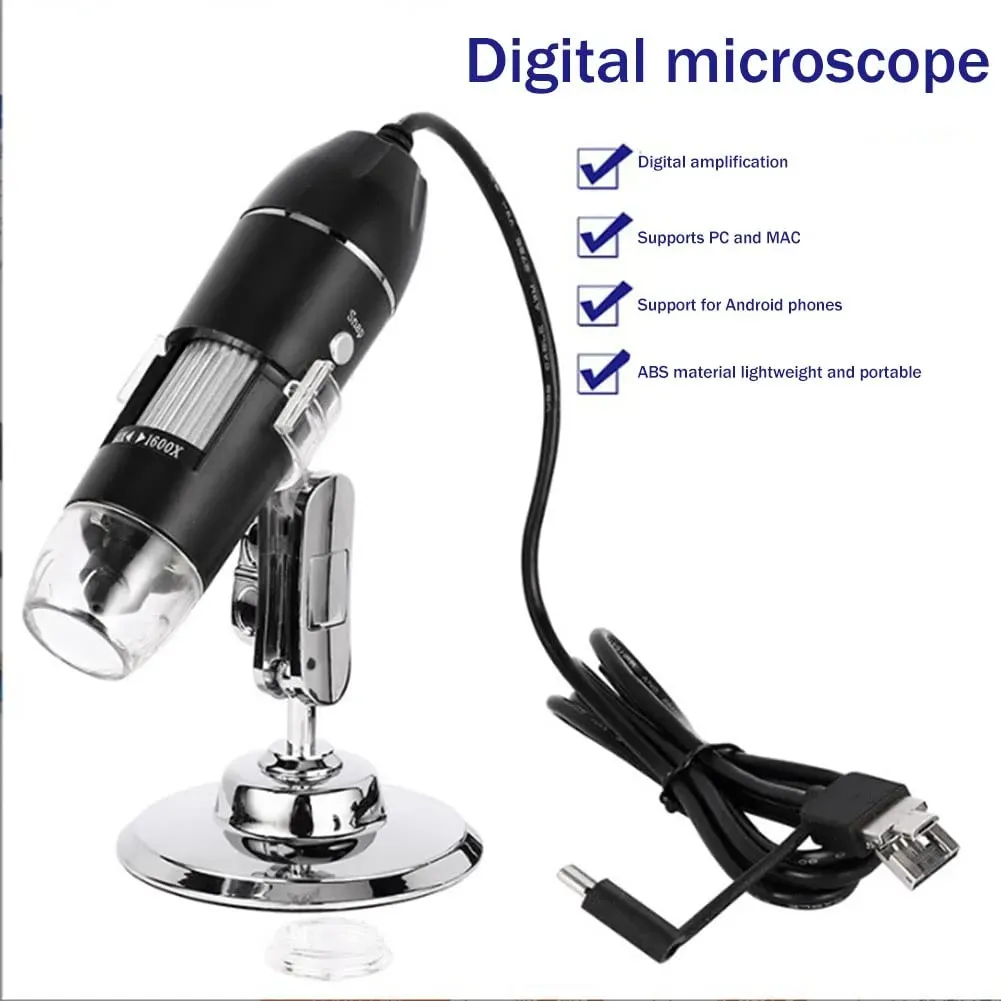
The Jiusion 1600X USB Digital Microscope is a plug-and-play USB microscope for stamp collecting. It uses digital magnification up to 1600X, and the view depends on your screen. For stamps, a sharp image at a modest setting is usually more useful than pushing the highest figure.
In practice you ignore the headline and work the way collectors always have — start low to frame the whole stamp, then move closer for a small patch:
- Light it well. The eight adjustable LEDs ring the lens; dim them for glossy or chalk-surfaced paper, or angle light across the surface to lift a plate flaw. Controllable light, not raw power, reveals texture.
- Keep it steady. The included adjustable metal stand fixes the height, so framing stays put and hand-shake does not blur fine detail.
- Focus by hand. The manual focus wheel sets the exact plane you care about.
- Capture what you find. Photos and video let you compare a stamp against a known-genuine reference and keep a record.
Getting it running
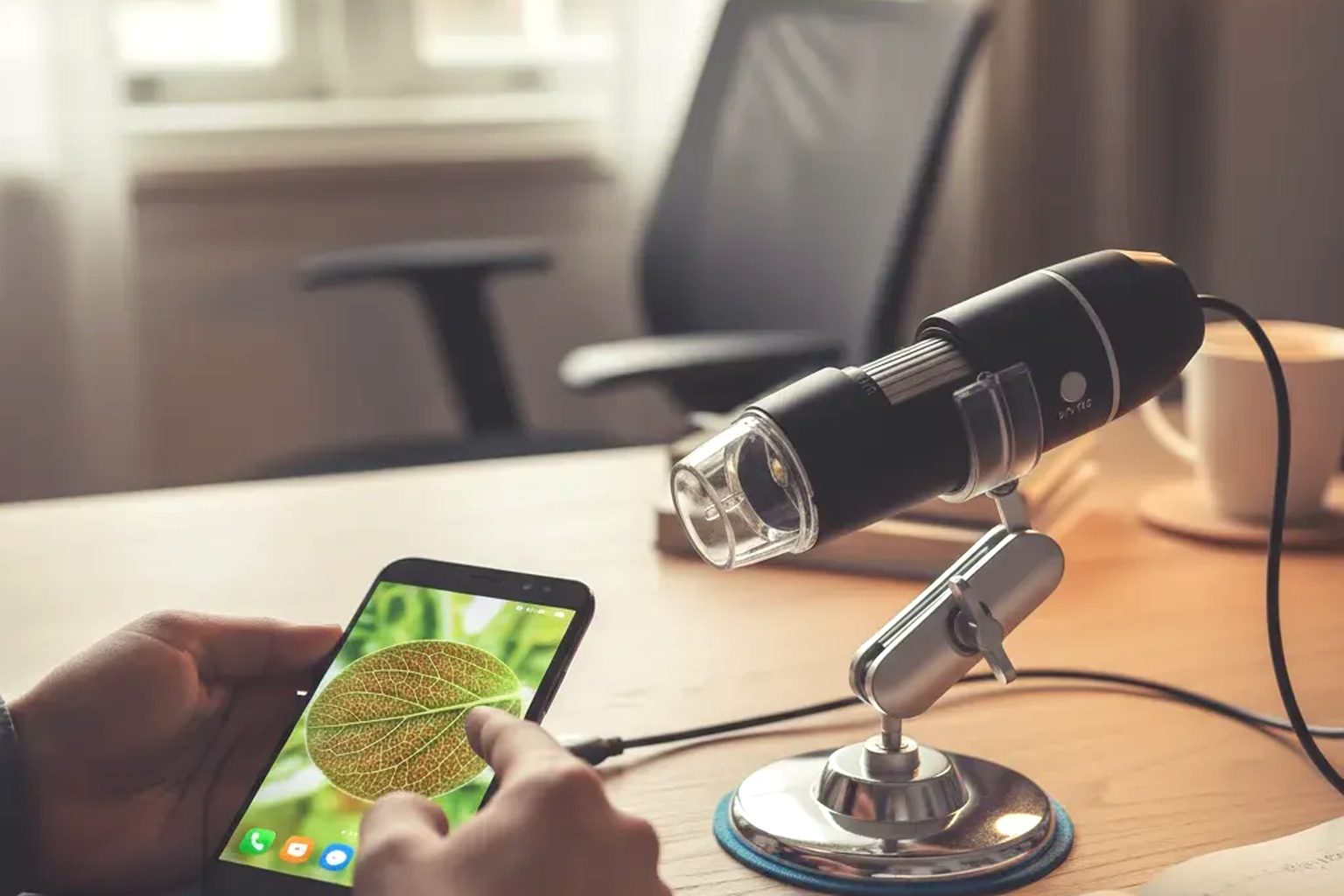
The Jiusion 1600X USB microscope uses USB-A, with Type-C and Micro USB adapters in the box for OTG Android. It works on Windows, Mac and OTG Android phones. Android must support USB On-The-Go; Google’s Android USB host documentation explains why this depends on the handset, so run a free “OTG checker” app before you buy. iPhone and iPad are not supported, so plan to view on a PC or a supported Android device. It is USB-powered with no batteries, and it is built for close-up viewing and inspection only — not for any medical or diagnostic use.
At £34.99 inc VAT (marketplace prices and delivery can change), the Jiusion USB Digital Microscope is an affordable, honest place to start. For advice tailored to the hobby, see our best digital microscope for stamp collectors guide, and for a wider view across models our best digital microscope buying guide covers what to weigh up before you spend.
FAQ
How much magnification do I need to see stamp perforations? Very little. Perforation holes are large features, so about 10x to 20x is plenty to inspect and count them — you are measuring holes per 2 cm, not resolving microscopic detail. A whole-stamp view at 5x to 10x is fine for everyday sorting.
Is a 1000x USB microscope any good for stamps? The “1000x” is a digital, screen-dependent number, so on its own it means little. For stamps, resolvable detail, even lighting and a steady stand matter far more than a headline figure, and modest magnification suits the hobby.
Will it work with my iPhone or iPad? No. This microscope is for Windows, Mac and OTG Android phones. iPhone and iPad are not supported. Check your Android phone supports OTG first.